Ink
shield.
Protecting creative work in the age of generative AI. Inkshield applies carefully generated perturbations to artwork, nearly invisible to humans, disruptive to the vision models behind large-scale scraping.
See what a scraper sees.
Then break its vision.
Drop in an image and apply Inkshield. Your file is uploaded and protected server-side by a real ensemble PGD attack against ResNet-50 and MobileNetV2. Before-and-after predictions from both models show exactly how each is fooled, then download the protected file.
note: your image is uploaded and protected server-side by a real 4-step ensemble PGD attack against ResNet-50 and MobileNetV2 (~5–15s on CPU). files are stored privately on S3 and returned as time-limited presigned URLs. stronger ε = stronger disruption at the cost of slight visible grain.
The line between inspiration and scraping has blurred. The essence of a body of work now dissolves into training sets, without permission, without attribution, without consent.
Inkshield was created as a form of digital self-defense. A way for artists to protect their visual identity and retain control over how their work is used online, using the same adversarial techniques that expose weaknesses in neural networks.
An adversarial pipeline,
tuned for artists.
Inkshield runs a real ensemble PGD attack server-side against a pretrained ResNet-50 and MobileNetV2. The perturbation is nearly imperceptible to a viewer, but disruptive to the feature extractors that power scrapers and AI captioners.
Projected Gradient Descent. Iteratively nudges pixels along the gradient sign, clipped to an epsilon-ball, stronger protection than single-step FGSM.
Gradients are averaged across ResNet-50 and MobileNetV2 so the perturbation transfers, disrupting more than a single architecture would.
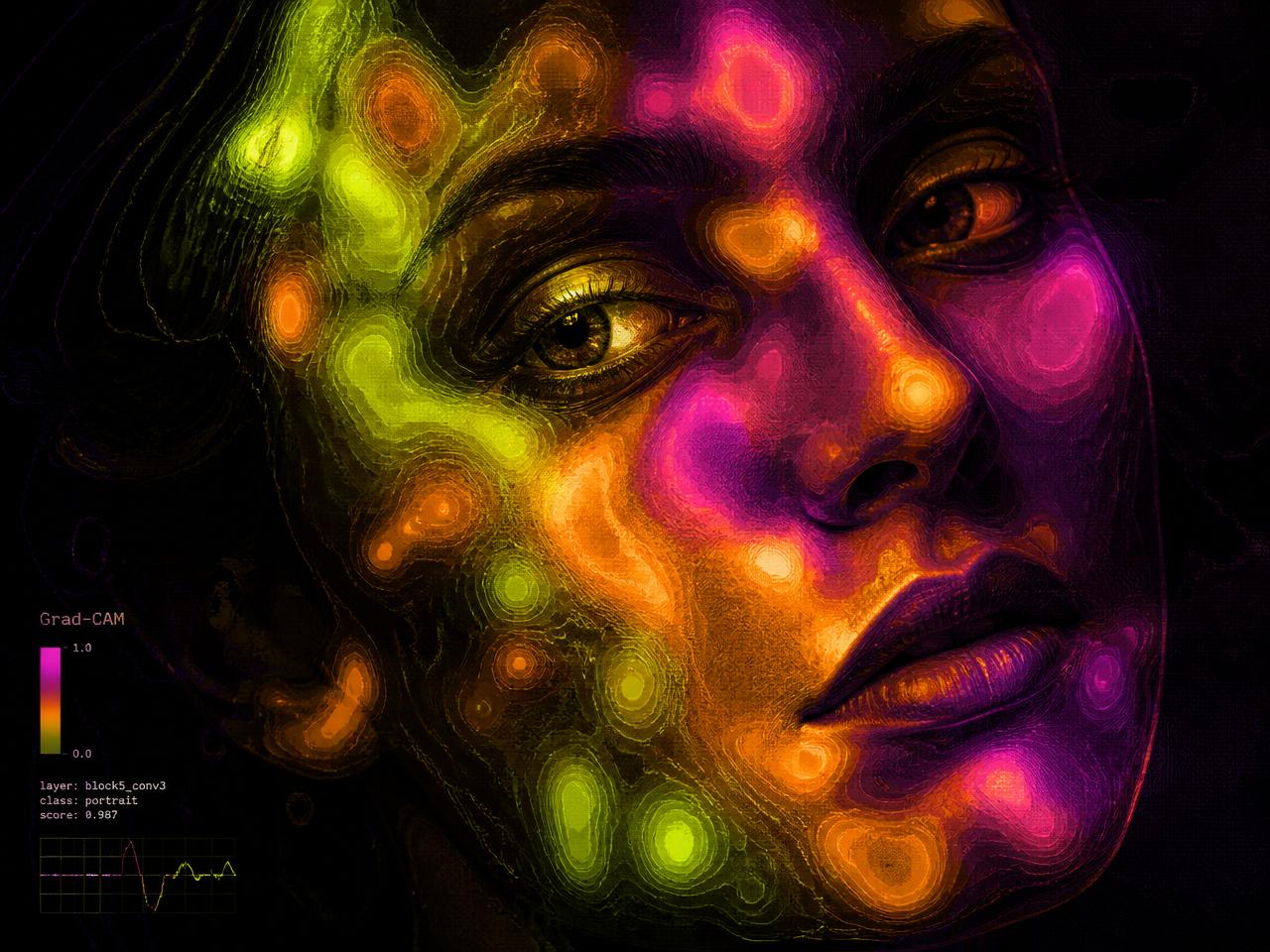
Real models,
real attack.
The full PyTorch and TensorFlow ensemble PGD attack runs on the ML service, not a browser approximation:
- → image uploaded through the Go API gateway to the FastAPI ML service
- → multi-step PGD iterates the gradient sign against the ResNet-50 + MobileNetV2 ensemble
- → protected image stored privately in S3, tied to your account, returned as a presigned URL
Pick your epsilon.
A dial from invisible to unmistakable. The default of 0.020 sits at the sweet spot, minor grain only visible at zoom, strong enough to disrupt the ensemble's classification.
Your images,
privately stored.
Images are uploaded over HTTPS, protected in isolation, and stored in a private S3 bucket tied to your account. No third-party AI services and no public access, unless you choose to publish to the gallery, only you hold the presigned download link.
A real backend,
not a browser trick.
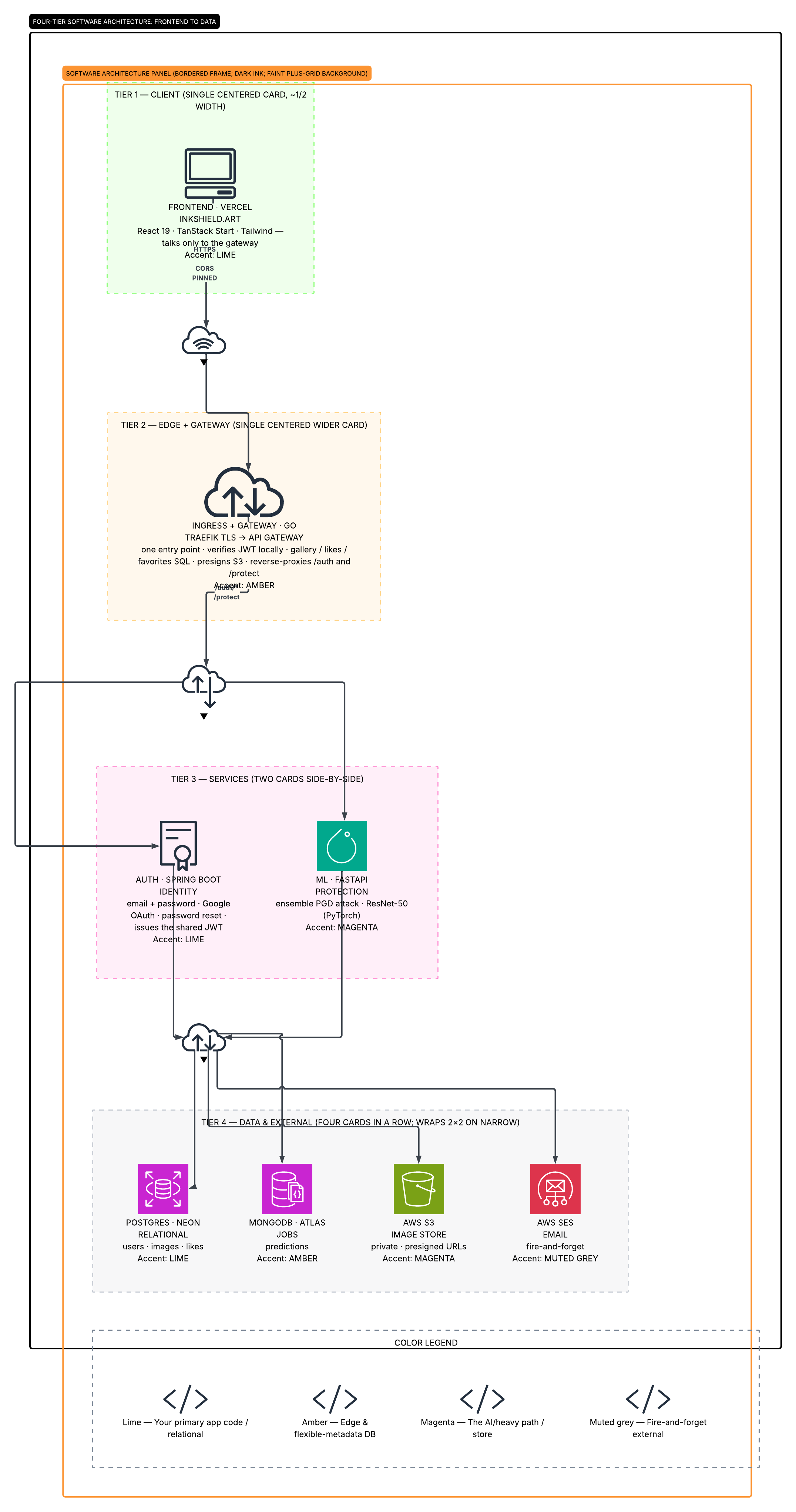
- PyTorch ResNet-50
- TF MobileNetV2
- Ensemble PGD attack
- FastAPI ML service
- Go API gateway
- Spring Boot auth
- PostgreSQL
- MongoDB
- AWS S3
- k3s cluster
- React 19
- TanStack Start
- Tailwind v4
Works from the
community.
Protected images that Inkshield users chose to publish. Open the full gallery to browse, sort, and like your favorites.
Ink,
not datasets.
Inkshield sends your image to a real ensemble PGD attack running on the ML service. The protected file lands in private S3 storage on your account and comes back as a time-limited download link. Load your art, dial in a shield, download the protected file.